Why Lincoln Park Is Chicago's Best Neighborhood for Young Professionals
Lincoln Park combines walkability, transit access, green space, and vibrant dining in one of Chicago's safest neighborhoods. If you're moving to Chicago for work, school, or an internship, this is the neighborhood that checks every box — and the one that most young professionals land in for a reason.
Bounded roughly by North Avenue to the south, Diversey Parkway to the north, Lake Michigan to the east, and the Chicago River to the west, Lincoln Park covers about 3.6 square miles of prime North Side real estate. The neighborhood takes its name from the 1,208-acre park that runs along its eastern edge — the largest public park in Chicago and one of the most beautiful urban green spaces in the country.
Lincoln Park's median household income is approximately $105,000, reflecting its position as one of Chicago's most desirable neighborhoods (source: U.S. Census Bureau). But that figure doesn't tell the full story. The neighborhood draws a wide range of residents — from DePaul students and hospital workers to first-job professionals and young families. It's affluent without being exclusive, polished without being sterile.
The tree-lined residential streets feel distinctly different from the dense high-rise neighborhoods to the south. Victorian greystones and brownstones sit alongside modern mid-rises. It's the kind of place where you know the barista at your corner coffee shop and can walk to dinner, a live blues show, and a late-night slice of Pequod's without ever calling a rideshare.
1,208
Acres of parkland on Lincoln Park's lakefront
What sets Lincoln Park apart from other popular neighborhoods like Wicker Park or Lakeview is its balance. You get the nightlife and restaurant scene without the noise of Wrigleyville, the charm and walkability of Old Town without the cramped quarters, and the green space and lake access that no inland neighborhood can match. For young professionals who want to live well in Chicago, Lincoln Park is the starting point — and for many, the neighborhood they never leave.
Getting Around Lincoln Park
You don't need a car here. Lincoln Park is one of the most connected neighborhoods in Chicago, with CTA rail lines, bus routes, and bike infrastructure that make getting anywhere in the city straightforward. The neighborhood scores a 90 Walk Score and an 85 Bike Score, and most residents use transit, a bike, or their feet as their primary transportation.
CTA Rail Lines
The Red Line runs through the western edge of the neighborhood, with North/Clybourn station putting you in the Loop in about 15 minutes. This is the line you'll use most — it runs 24 hours and connects you to downtown, Wrigleyville, Chinatown, and the South Side.
The Brown Line serves the heart of Lincoln Park with two stations: Fullerton (which also connects to the Red and Purple Express lines) and Armitage. The Brown Line runs through the Loop elevated tracks and out to Albany Park, making it useful for reaching the West Side and Northwest Side neighborhoods.
Sedgwick station on the Brown Line sits at the neighborhood's southern edge, near Old Town, and is handy for reaching the Merchandise Mart and River North.
According to the CTA, approximately 55,000 riders pass through Fullerton station daily, making it one of the busiest stations in the system — a reflection of how central Lincoln Park is to the city's transit network.
Bus Routes
Three bus routes are particularly useful for Lincoln Park residents:
- #8 Halsted — runs north-south along Halsted Street, connecting to the South Loop, UIC, and Greektown
- #73 Armitage — runs east-west along Armitage Avenue from the lakefront to the western neighborhoods
- #74 Fullerton — runs east-west along Fullerton Avenue, connecting DePaul's campus to Fullerton Beach and the lakefront
Biking and Divvy
Lincoln Park is laced with protected bike lanes, and Divvy bike-share stations appear on nearly every other block. The Lakefront Trail runs along the neighborhood's entire eastern edge — an 18-mile path connecting the South Side to Edgewater that's perfect for commuting, running, or a weekend ride. The 606/Bloomingdale Trail, a 2.7-mile elevated rail-trail, starts just two blocks from Post Chicago and runs west through Bucktown and Humboldt Park.
Annual Divvy memberships run about $120/year, and many Lincoln Park residents use the system as their primary commute option.
For a deeper dive into navigating the neighborhood car-free, see our complete guide: Getting Around Lincoln Park Without a Car.
Where to Eat and Drink
Lincoln Park's dining scene ranges from legendary cheap eats to Michelin-starred fine dining, and the density of good restaurants per block rivals any neighborhood in the city. The area supports over 200 restaurants and bars, according to the Choose Chicago neighborhood directory.
Quick Bites
- Sultan's Market — The city's best falafel, hands down. The Lincoln Park location on North Clark has a small patio and a loyal following. A full meal runs under $12.
- Pequod's Pizza — The caramelized-crust deep dish that Chicagoans actually eat (as opposed to the tourist spots). Expect a wait on weekends — it's worth it.
- Floriole — A French-inspired bakery and cafe on North Halsted. The morning buns and quiche are exceptional, and the space is bright enough for a working lunch.
- RJ Grunts — A Lincoln Park institution since 1971, known for burgers, salad bar, and a vibe that hasn't changed in decades. It's a Lettuce Entertain You original.
Sit-Down Dining
- Boka — One of Chicago's best restaurants, period. Michelin-starred New American cuisine in a warm, intimate setting on North Halsted. The tasting menu is a splurge worth making for a special occasion.
- North Pond — Seasonal, nature-driven cuisine served in an Arts and Crafts-era pavilion inside Lincoln Park. The setting alone — overlooking a pond surrounded by trees — is unlike any other restaurant in Chicago.
- Gemini — A neighborhood bistro on North Halsted with a menu that leans French-American. Great brunch, excellent cocktails, and a patio that's packed all summer.
- Mon Ami Gabi — Classic French bistro fare at the southern edge of Lincoln Park, right on North Clark. The steak frites and croque monsieur are reliable every time.
200+
Restaurants and bars in Lincoln Park
Coffee Shops for Remote Work
If you work remotely — or just need a reliable study spot — Lincoln Park has some of the best coffee shops in Chicago:
- Colectivo Coffee — The Fullerton location has ample seating, strong WiFi, and stays open late. It's a neighborhood living room.
- Gaslight Coffee Roasters — A smaller, more focused space on North Lincoln Avenue. Single-origin pour-overs and a quiet atmosphere.
- Bourgeois Pig — A dimly lit, two-story cafe in a converted brownstone on Fullerton. It's been a DePaul student staple for years, with nooks and corners that feel designed for deep work.
For a full roundup of our favorites, check out 12 Best Coffee Shops Near Lincoln Park for Remote Workers.
Bars and Nightlife
Lincoln Park's nightlife tilts more "neighborhood bar" than "club scene," which is a good thing.
- The J. Parker — A rooftop bar at the Hotel Lincoln with panoramic views of the park and the lake. It's the kind of place you bring out-of-town visitors.
- Delilah's — A legendary dive bar on North Lincoln Avenue with 700+ whiskeys and a punk-rock jukebox. It's been open since 1993 and has the kind of character you can't manufacture.
- Kingston Mines — One of Chicago's last great blues clubs, operating on North Halsted since 1968. Two stages, live music every night, and a crowd that ranges from 21 to 71.
Parks, Recreation, and the Lakefront
No neighborhood in Chicago gives you more green space than Lincoln Park. The neighborhood's namesake park stretches over 1,208 acres along the lakefront — for context, that's larger than New York's Central Park — and it's the centerpiece of daily life here.
Lincoln Park (the Park)
The park runs nearly 7 miles from North Avenue to Ardmore Avenue, encompassing beaches, harbors, playing fields, gardens, a conservatory, a nature museum, and one of the last free zoos in the country. Most residents use the park daily: morning runs on the lakefront, afternoon walks through the Alfred Caldwell Lily Pool, or summer evenings grilling at one of the designated picnic areas.
Lincoln Park Zoo
The Lincoln Park Zoo is free to visit year-round — one of the few remaining free-admission zoos in the United States. It draws approximately 3.6 million visitors annually (source: Lincoln Park Zoo annual report) and hosts seasonal events like ZooLights in winter and the outdoor concert series in summer. For residents, it functions less as a tourist attraction and more as a neighborhood park that happens to have lions.
North Avenue Beach
North Avenue Beach is Lincoln Park's summer headquarters. The beach house (shaped like a steamship) has a rooftop bar, volleyball courts line the sand, and the beach itself is one of the best swimming spots on Lake Michigan. From Memorial Day through Labor Day, this is where the neighborhood congregates.
The 606/Bloomingdale Trail
The 606 Trail is a 2.7-mile elevated park built on a former rail line, running from Ashland Avenue west to Ridgeway Avenue. The eastern trailhead is just two blocks from Post Chicago, making it one of the most convenient amenities for residents. The trail is excellent for running, biking, or a sunset walk with skyline views. It connects Lincoln Park to Bucktown, Humboldt Park, and Logan Square — three neighborhoods with their own distinct food and bar scenes.
More Green Space
- Oz Park — A family-friendly park at Webster and Larrabee with sculptures of Wizard of Oz characters, a playground, sports fields, and a community garden.
- Diversey Harbor — A marina and park at the north end of the neighborhood, with kayak rentals, a driving range (Diversey Range), and a seasonal beer garden.
- North Pond Nature Sanctuary — A restored prairie wetland inside Lincoln Park, home to migratory birds and one of the quietest spots in the neighborhood.
Explore Lincoln Park From Home Base
Post Chicago puts you steps from the lakefront, the 606 Trail, and everything Lincoln Park has to offer. Furnished rooms from $1,350/mo, all-inclusive.
Check AvailabilityUniversities and Schools Nearby
Lincoln Park is one of the best neighborhoods in Chicago for students, and not just because of DePaul. The CTA rail network connects you to nearly every major university in the city within 30 minutes.
DePaul University — Lincoln Park Campus
DePaul's Lincoln Park campus is just 0.5 miles from Post Chicago, centered around the intersection of Fullerton and Sheffield. It's the university's main campus for liberal arts, sciences, education, and music programs. The campus is fully integrated into the neighborhood — DePaul students fill the coffee shops, restaurants, and bars along Sheffield and Halsted, and the university's events (concerts at the Holtschneider Performance Center, speakers at the Student Center) are open to the community.
DePaul enrolls approximately 21,000 students across its two campuses (Lincoln Park and the Loop), with about 14,000 on the Lincoln Park campus.
Northwestern University
Northwestern's Evanston campus is accessible via the Red Line to Howard, then a transfer to the Purple Line — about 45 minutes door-to-door. During peak hours, the Purple Express from Fullerton station cuts that to roughly 35 minutes. Many Northwestern graduate students and medical residents live in Lincoln Park for its nightlife and dining, commuting north for classes and shifts.
Loyola University Chicago
Loyola's Rogers Park campus sits on the Red Line at Loyola station — a straight shot north from North/Clybourn in about 25 minutes. No transfers needed.
University of Illinois at Chicago (UIC)
UIC's campus near Halsted and Roosevelt is reachable via the Blue Line from a quick transfer at Fullerton (Brown Line to Blue Line at Clark/Lake). Total commute time is about 30 minutes.
For students looking for off-campus housing in the area, see our dedicated guide: Off-Campus Housing Near DePaul.
Cost of Living in Lincoln Park
Lincoln Park is not Chicago's cheapest neighborhood — but it offers strong value when you factor in walkability, safety, transit access, and quality of life. The premium you pay over neighborhoods further from the lake is offset by lower transportation costs (most residents don't need a car) and the sheer density of free amenities (the park, the zoo, the beaches).
Rent
A traditional one-bedroom apartment in Lincoln Park typically runs $1,800 to $2,400/mo unfurnished, not including utilities. Studios start around $1,400, and two-bedrooms range from $2,400 to $3,200. These figures reflect median asking rents tracked by the U.S. Census Bureau's Housing Vacancies and Homeownership survey and local market data for Chicago neighborhoods.
Utilities (electric, gas, water, internet) add roughly $150 to $250/mo on top of rent in a traditional apartment. Factor in renter's insurance ($15-30/mo), and a standard Lincoln Park one-bedroom costs $2,000 to $2,700/mo all-in before groceries and transportation.
Groceries
Lincoln Park has excellent grocery options at various price points:
- Trader Joe's (Clybourn Avenue) — the go-to for affordable staples
- Whole Foods (North Kingsbury) — premium selection, higher prices
- Mariano's (North Sheffield) — a solid middle-ground with a good deli and prepared foods section
- ALDI (North Clybourn) — budget-friendly basics
The average single person in Lincoln Park spends roughly $350 to $500/mo on groceries, depending on cooking habits and store choices.
Compared to Nearby Neighborhoods
| Category | Lincoln Park | Wicker Park | Lakeview |
|---|---|---|---|
| 1BR Rent (avg) | $1,800-2,400 | $1,700-2,200 | $1,600-2,100 |
| Walk Score | 90 | 95 | 85 |
| Transit Score | 80 | 72 | 78 |
| Green Space | Excellent | Limited | Good |
| Lake Access | Direct | None | Direct |
Wicker Park is slightly cheaper but lacks lakefront access. Lakeview is more affordable but has a louder nightlife scene (especially near Wrigley Field). Lincoln Park strikes the balance. For a detailed comparison, read: Lincoln Park vs. Wicker Park vs. Lakeview: Where Should You Live?.
The Co-Living Advantage
Traditional apartments in Lincoln Park require a security deposit (typically one month's rent), furniture purchases ($3,000-5,000 to furnish from scratch), and separate utility accounts. For someone moving to Chicago for the first time — especially for a job, internship, or school — that's a lot of upfront friction and cost.
Co-living at Post Chicago starts at $1,350/mo with everything included: furniture, utilities, WiFi, weekly cleaning of shared spaces, and building amenities. There are no surprise bills, no furniture to buy, and no utility accounts to set up. You show up with a suitcase.
$1,350
Starting monthly rent, all-inclusive
For a detailed look at how co-living compares to traditional renting in Chicago, see our complete guide: The Complete Guide to Co-Living in Chicago.
Living at Post Chicago in Lincoln Park
Post Chicago sits at 853 W Blackhawk St in the heart of Lincoln Park, on a tree-lined block between Halsted and Clybourn. The location puts you two blocks from the 606 Trail, steps from the North/Clybourn Red Line station, and within walking distance of everything covered in this guide — the restaurants, the parks, the transit, the grocery stores.
The Building
Post Chicago is a modern co-living building designed for young professionals, students, and anyone relocating to Chicago who wants a turnkey living experience. Every room comes fully furnished with premium furniture, quality linens, and everything you need to be comfortable from day one.
The building's shared amenities include:
- Fitness center — fully equipped, no gym membership needed
- Co-working spaces — dedicated desks, phone booths, and communal work tables with high-speed WiFi
- Rooftop terrace — outdoor seating, grill area, and skyline views
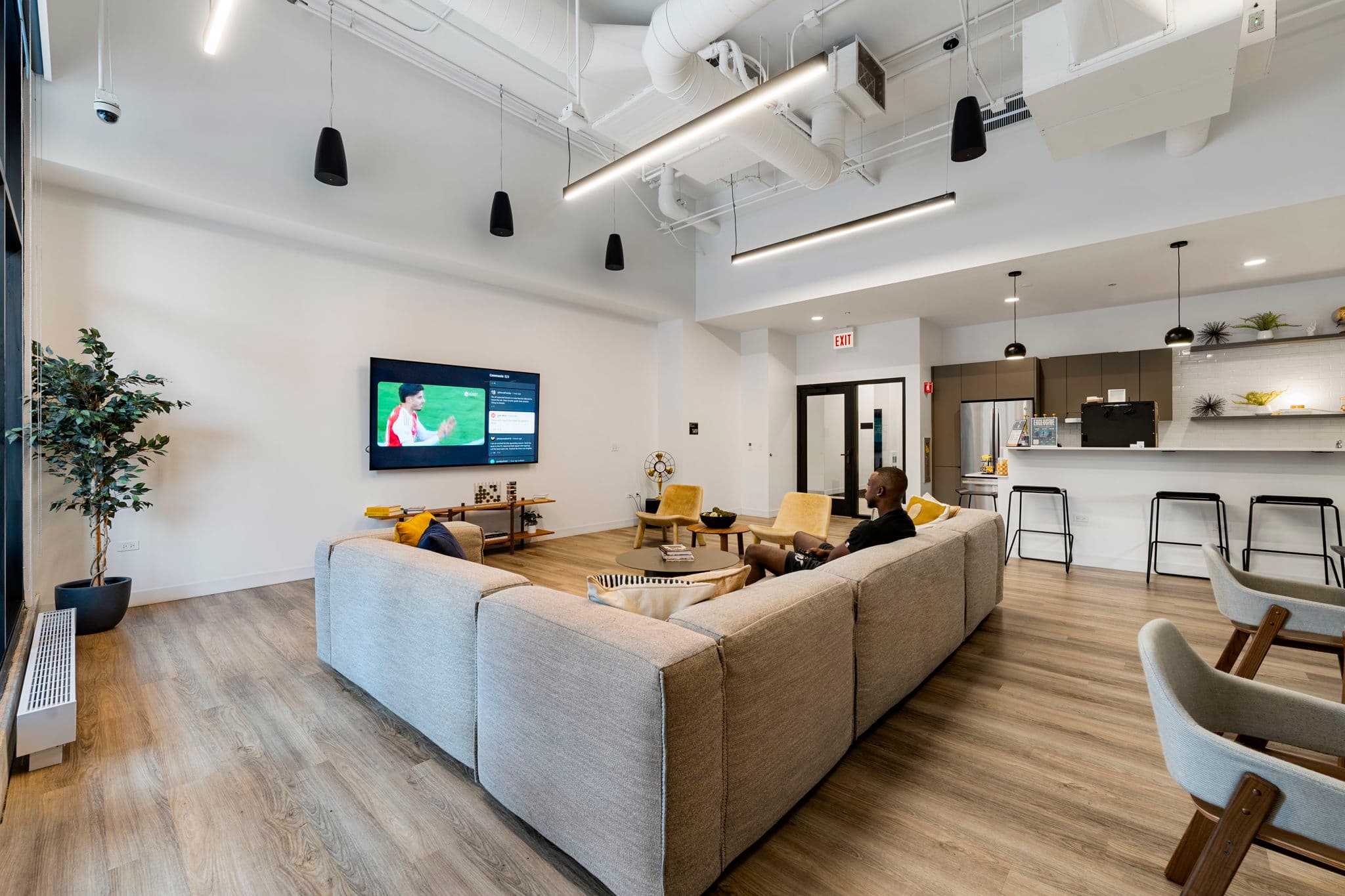
- Community lounge — coffee bar and social space for meeting other residents
- Weekly cleaning of all shared spaces, with household supplies restocked
Room Options and Pricing
Post Chicago offers Private Rooms and Premium Private Rooms in shared apartments. Every room includes a personal lock, furnished bedroom, and access to a shared kitchen, living room, and in-unit washer/dryer.
- Private Rooms start at $1,350/mo at a 14-month lease
- Premium Private Rooms (with en-suite bathroom) start at $1,550/mo at a 14-month lease
- All pricing is all-inclusive — utilities, WiFi, cleaning, amenities, and furnishings are bundled in
Flexible Leases
Unlike most Lincoln Park apartments that require a 12-month commitment, Post Chicago offers lease terms from 3 to 18 months. Shorter leases have a higher monthly rate; longer leases bring the price down. This flexibility makes Post Chicago especially popular with interns (3-6 month stays), students between semesters, and professionals who aren't ready to commit to a full year in one neighborhood.
Who Lives Here
Post Chicago residents are a mix of DePaul students, medical interns at nearby hospitals, young professionals starting their first Chicago job, and people relocating to the city from out of state. The building attracts people who value community — residents regularly use the co-working spaces together, host dinners in shared kitchens, and meet through building events.
It's not a dorm. It's not a hostel. It's a thoughtfully designed living space for adults who want convenience, community, and a home base in one of Chicago's best neighborhoods.
Ready to See Your New Home?
Schedule a tour of Post Chicago and explore furnished rooms in Lincoln Park.
Check AvailabilityDive Deeper
This guide covers the essentials, but Lincoln Park has more layers than any single article can capture. Explore our in-depth guides on specific topics:
- 12 Best Coffee Shops Near Lincoln Park for Remote Workers — our curated list of the best places to work, study, and caffeinate in the neighborhood
- Getting Around Lincoln Park Without a Car: CTA & Transit Guide — a detailed breakdown of every transit option, route, and hack for car-free living
- Lincoln Park vs. Wicker Park vs. Lakeview: Where Should You Live? — a head-to-head comparison of Chicago's three most popular young-professional neighborhoods
- Off-Campus Housing Near DePaul University — everything DePaul students need to know about finding housing in Lincoln Park
- The Complete Guide to Co-Living in Chicago — how co-living works, who it's for, and why it's reshaping how young professionals live in the city
FAQ