The Newcomer Loneliness Problem Nobody Talks About
You got the job. You signed the lease. You moved to Chicago with two suitcases and a vague plan to "figure it out." And now it is a Tuesday night, you are eating takeout alone in your apartment, and the city that seemed so full of possibility from a distance feels enormous and indifferent.
This is not a personal failing. It is the single most common experience among people who relocate to a new city as adults.
According to the U.S. Census Bureau, roughly 8.2 million Americans moved to a different state in the most recent annual survey. The majority are between 20 and 35 years old — starting jobs, beginning graduate programs, chasing opportunities. What the migration data does not capture is what happens after the move: the social reset that comes with leaving behind every relationship you built over the previous four to ten years.
Research from the University of Kansas found that it takes approximately 50 hours of shared time to move from acquaintance to casual friend, 90 hours to become a real friend, and over 200 hours to develop a close friendship. Those numbers are staggering when you consider that most adults in a new city are spending 40 to 50 hours a week at work and the rest trying to set up a functional life. Where do 200 hours of organic social time come from when you do not know a single person within a hundred miles?
50+
Hours of shared time to form a casual friendship
Based on friendship formation research from the University of Kansas
The loneliness is not just uncomfortable — it is a genuine health concern. The U.S. Surgeon General's Advisory on the Epidemic of Loneliness and Isolation found that prolonged social disconnection carries health risks equivalent to smoking 15 cigarettes a day. For young adults who relocate without an existing social network, the first six months in a new city represent a critical window. The choices you make about where and how you live during that period determine how quickly — or whether — you build a meaningful social life.
This guide is about making those choices intentionally. Not with platitudes about "putting yourself out there," but with specific, tested strategies that actually work in Chicago.
Why Organic Community Beats App-Based Friend-Finding
The instinct when you arrive in a new city and feel lonely is to download an app. Bumble BFF, Meetup, Eventbrite — the promise is that technology can solve social isolation the same way it solved dating and restaurant reservations.
It cannot. Or, more precisely, it can introduce you to people, but it cannot build the kind of friendships that actually matter.
Here is why. The research on friendship formation consistently identifies two variables that predict whether an acquaintance becomes a friend: proximity and repeated unplanned interactions. This was first documented by psychologists Leon Festinger, Stanley Schachter, and Kurt Back in their landmark 1950 MIT study on dormitory friendships. They found that the single strongest predictor of who became friends was not shared interests, not personality compatibility — it was physical proximity and the frequency of casual, unplanned encounters.
Think about how your closest friendships actually formed. Probably not through a scheduled one-on-one coffee with a stranger. More likely through a dorm hallway, a shared class, a workplace kitchen, a gym you both attended at the same time every morning. The friendship emerged from the accumulation of dozens of small, low-stakes interactions over weeks and months.
App-based friend-finding inverts this model. You meet a stranger for coffee or drinks. The interaction is high-stakes — both of you are silently evaluating whether this person is worth investing more time in. There is no natural reason to see each other again unless someone actively initiates a second meetup. Most people do not, because life is busy and the activation energy required to schedule plans with someone you met once is surprisingly high.
One-off Meetup events have a similar problem. You attend a trivia night with 30 strangers, have a few pleasant conversations, and then everyone disperses. You might exchange numbers. You probably will not follow up. And even if you do, you are back to the high-friction model of intentionally scheduling time with someone you barely know.
The environments that reliably produce friendships are the ones that create repeated, unplanned contact by default. In college, this was the dorm. After college, the workplace fills part of this role — but remote and hybrid work has eroded even that. For adults relocating to a new city, the housing environment is the most underutilized tool for building social connections.
This is, fundamentally, what co-living provides.
How Co-Living Creates Natural Social Connections
Co-living works for friendship-building because it recreates the conditions that made college dorm friendships feel effortless — without the shared bathrooms and twin XL beds.
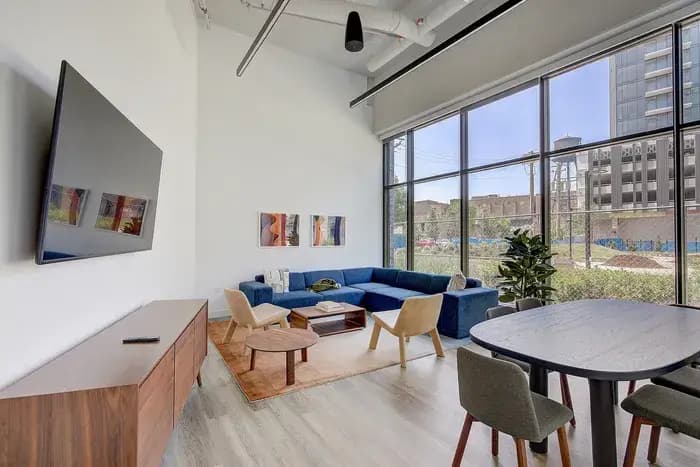
At Post Chicago, you rent a private, furnished bedroom in a shared apartment with two or three other residents. Your room is yours — private, locked, your space. But every day, you share a kitchen, a living room, and a building full of common amenities with people who are overwhelmingly in the same life stage: new to the city, starting something, looking for connection.
The friendships do not happen because someone organizes them. They happen because you are making coffee in the kitchen at 7:30 AM and your housemate walks in. You are both heating up dinner at 8 PM and end up eating together. You are in the building lounge working on your laptop and someone sits down at the next table. These are exactly the kind of low-stakes, repeated, unplanned interactions that the friendship research says matter most.
The building's shared amenities amplify this effect. The rooftop terrace with the fire pit becomes the place where residents drift after work on warm evenings. The fitness center at 6 AM has the same five people every morning. The coffee bar creates a daily ritual that mirrors the role a neighborhood cafe plays — except it is in your building, and the people you see there are the people who live twenty feet from you.
The roommate matching process is designed with compatibility in mind, which means the people you share an apartment with are likely to be in a similar life stage, with similar schedules and habits. This is not random — it is a deliberate effort to create the conditions where organic connection is most likely to happen.
None of this means co-living guarantees you a best friend in your first month. It does not. What it guarantees is proximity and repeated contact — the two ingredients that make friendship possible. The rest is up to you.
According to the National Multifamily Housing Council, renter households headed by someone under 35 are the fastest-growing segment of the rental market, and surveys consistently show that community and social connection are among the top factors — alongside price and location — driving housing decisions in this demographic. Co-living is not a niche product for people who cannot afford a solo apartment. It is a deliberate lifestyle choice for people who understand that where you live shapes who you know.
Learn more about what co-living includes and how the all-inclusive model frees up your time and energy for the things that actually matter — like building a social life.
Lincoln Park's Social Infrastructure
Co-living gives you a built-in home community, but you also need to build a life outside your building. This is where your neighborhood matters enormously — and Lincoln Park is one of the strongest neighborhoods in Chicago for newcomers building a social life from zero.
According to Choose Chicago, Lincoln Park consistently ranks among the city's most walkable and socially active neighborhoods. It has one of the highest concentrations of residents aged 25 to 34 in the Chicago metro area, which means the restaurants, bars, gyms, and recreational activities in the neighborhood are designed for and populated by people in your age range.
Here is what the social infrastructure actually looks like, organized by the type of connection it facilitates.
Sports Leagues and Recreation
The Chicago Sport and Social Club runs dozens of leagues in and around Lincoln Park every season — volleyball, kickball, softball, soccer, dodgeball, bowling, and more. The leagues are explicitly designed to be social. Teams are often made up of free agents who sign up individually and get placed together, which means everyone is in the same position: looking to meet people. Games are followed by sponsor bar nights. This is one of the most effective friend-making tools in Chicago because it combines physical activity, team bonding, and repeated weekly contact over an 8 to 10 week season.
Beyond organized leagues, Lincoln Park offers informal recreation that creates regular social touchpoints. North Avenue Beach has pickup volleyball games throughout the summer. The Lincoln Park running and cycling paths along the lakefront attract a community of regulars. The Lincoln Park Athletic Club and neighborhood studios create gym friendships through the same repeated-contact mechanism that makes co-living work.
Neighborhood Bars and Restaurants
Lincoln Park's bar scene along Halsted Street, Armitage Avenue, and Clark Street is specifically geared toward the 25 to 35 demographic. Halligan Bar, Gaslight Bar and Grille, and The Pony Inn are neighborhood staples where regulars are common and bartenders know names. This is not the anonymous nightclub scene of River North — these are neighborhood spots where showing up on the same night each week puts you on a first-name basis with other regulars within a month.
For daytime socializing, Lincoln Park's coffee shop scene is equally strong. Becoming a regular at a coffee shop near your building creates a third place — somewhere between home and work where casual social interaction happens naturally. The barista who remembers your order, the person who always sits at the next table, the group that meets there every Saturday morning — these become connective threads in your social fabric.
Community Events and Organizations
Lincoln Park Zoo hosts seasonal events — ZooLights, evening programming, outdoor concerts — that attract a young, social crowd and provide natural conversation starters. The neighborhood's proximity to the lakefront means summer brings a steady calendar of outdoor events: festivals, concerts at the park, food and drink events along the waterfront.
Volunteer organizations are another underrated path to friendship. The Lincoln Park Community Services network offers regular volunteer shifts that create the kind of repeated-contact environment where friendships form. Unlike a one-time volunteer event, committing to a weekly or biweekly shift puts you in the same room with the same people — and shared purpose is a powerful accelerant for connection.
Why Neighborhood Choice Matters
Not every Chicago neighborhood offers this density of social infrastructure for newcomers. Lincoln Park's combination of demographics, walkability, recreational options, and neighborhood-scale bars and restaurants makes it disproportionately easy to build a social life — especially if you live in a building that already provides a home base of community. For a deeper look at what makes this neighborhood work for young transplants, read the Lincoln Park neighborhood guide.
Building Your Chicago Friend Group: A Realistic Timeline
One of the most damaging misconceptions about moving to a new city is that you should have a full social life within the first few weeks. Social media reinforces this — everyone else seems to be surrounded by friends at rooftop bars by their second weekend. The reality is slower, less photogenic, and completely normal.
Here is what an honest friendship timeline looks like for most Chicago newcomers, based on the research and the experience of hundreds of Post Chicago residents.
Months 1-2: The Acquaintance Phase
You meet a lot of people. Housemates, coworkers, people at events, the barista at your coffee shop. Most of these interactions are surface-level — names, where you are from, what you do for work. This is normal and necessary. You are building a wide base of acquaintances, and most of them will not become close friends. That is not failure. That is how social networks work.
During this phase, the most important thing you can do is say yes to everything. The housemate who invites you to a bar on Thursday — go. The coworker who mentions a weekend volleyball league — sign up. The coffee shop that hosts a trivia night — show up. You are not looking for your best friend yet. You are creating the conditions for one to emerge.
Months 3-4: The Regular Hangout Phase
If you have been consistent — showing up to the same league, the same coffee shop, the same building events — you will start to notice a shift. Certain acquaintances become people you genuinely look forward to seeing. You start making plans directly instead of relying on group events. Someone texts you about dinner without it feeling forced.
This is the phase where co-living residents have the biggest advantage. While someone living alone in a studio has to actively manufacture every social interaction, co-living residents have been accumulating hours of casual shared time simply by existing in their building. The 50-hour threshold for casual friendship? You cross it with your housemates almost without trying.
Months 5-6+: The Real Friend Phase
This is when acquaintances who survived the filter become actual friends. You know details about their lives beyond the basics. You have inside jokes. You text them about things that have nothing to do with making plans. You would call them if something went wrong.
According to research published in the Journal of Social and Personal Relationships, reaching this level of friendship requires crossing the 200-hour shared-time threshold. Six months of consistent, organic contact — living in the same building, attending the same weekly league, frequenting the same coffee shop — gets you there.
The critical insight is that this timeline is not a sign of failure. It is the biological and psychological reality of how human relationships form. The people who struggle most in new cities are not the ones who take six months to make close friends — that is everyone. The people who struggle are the ones who give up after two months because they expected it to happen faster.
What Accelerates the Timeline
Three factors consistently shorten the path from stranger to friend in Chicago:
-
Living in proximity to peers. Co-living is the most direct version of this. You cannot shortcut the hours required, but you can make those hours accumulate passively instead of actively.
-
Committing to a recurring activity. A weekly sports league, a regular volunteer shift, a standing gym time. One-off events do not work. Recurring contact does.
-
Choosing the right neighborhood. Living in a neighborhood where the demographics match your own — where the bars, restaurants, and activities cater to your age group — means every errand and evening out is a potential social interaction. Lincoln Park is exceptionally strong on this dimension.
If you are evaluating whether co-living is the right move for your situation, read 5 signs co-living is right for you for a straightforward assessment.
The Bottom Line
Moving to Chicago without knowing anyone is hard. There is no hack that eliminates the discomfort of starting over socially. But there are choices that make the process dramatically easier — and the single most impactful choice is where and how you live.
Co-living at Post Chicago puts you in a furnished, private room in a building full of people your age who are going through the same transition. Lincoln Park puts you in a neighborhood engineered for the social life of 20- and 30-somethings. The combination — built-in home community plus one of Chicago's strongest social neighborhoods — is the fastest path from "I don't know anyone" to "I have a group."
You will still need to put in the effort. You will still need to say yes when you would rather stay in. You will still need to be patient through the first few months when every friendship feels tentative. But the infrastructure will be working for you instead of against you. And that makes all the difference.
Read the complete co-living guide
Explore the Lincoln Park neighborhood guide
Learn about relocating to Chicago
Ready to Build Your Chicago Life?
Tour Post Chicago's furnished co-living community in Lincoln Park. Private rooms, shared spaces, and a building full of people your age.
Schedule a TourFAQ